How to Know If Someone Blocked You on WhatsApp (And How to Read the Signs Correctly)
WhatsApp doesn't tell you when someone blocks you. There's no notification, no banner, no message - just a gradual sense that something is off. Messages that used to show two ticks now show one. A profile that used to update has gone static. Calls that used to connect now go nowhere. It's designed to be ambiguous, and that ambiguity is exactly what makes it so frustrating to figure out.
The good news is that while no single sign confirms a block, the combination of several signals together is usually conclusive. Here's how to read them correctly.
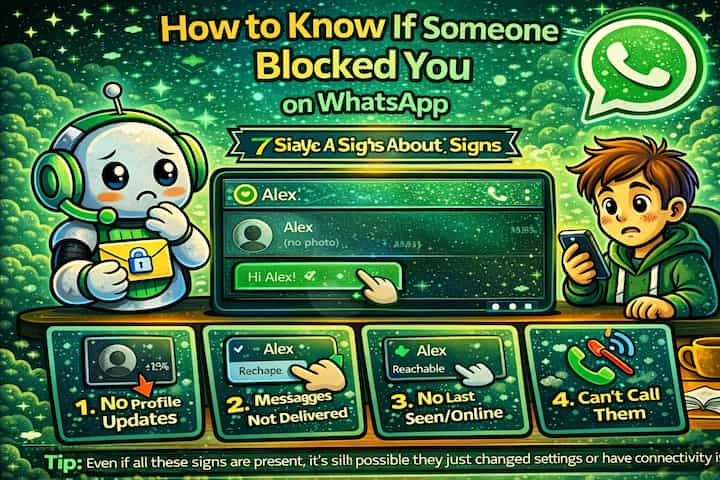
Quick Answer (For Those in a Hurry)
WhatsApp doesn't officially confirm blocks, but four signs together are highly reliable: your messages show only one grey tick indefinitely, you can no longer see their Last Seen or online status, their profile photo has stopped updating or disappeared, and WhatsApp won't let you add them to a group. No single sign is conclusive - but all four at once almost always means you've been blocked.
What This Guide Actually Helps You Do
This guide is designed for readers who want to change privacy or safety settings without misunderstanding what other people can still see. It adds value beyond the basic menu path by explaining which signals are hidden, which ones remain visible, and whether the change affects one conversation, one contact, or the whole account. That matters because privacy features are easy to overestimate, especially when screenshots, notifications, profile visibility, or group behavior still reveal context.
The practical goal is to leave you with a result you can verify, not just a menu path you followed. It also keeps the limits visible: this guide does not pretend to offer total invisibility, message secrecy against screenshots, or a way to bypass another person's privacy settings. It shows the reliable path, the trade-offs, and the checks that help you avoid repeating the same mistake.
Real Situations Where This Actually Comes Up
People search for this answer in very specific moments, and the emotional context matters for how you interpret what you find.
A conversation went cold after an argument or a difficult exchange. Things were tense, words were said, and now the silence feels different from normal. Messages aren't delivering the way they used to, and you can't tell if they're just offline or if something has changed. This is probably the most common situation - and also the one where it's most tempting to overinterpret a single grey tick as definitive proof, when it might not be.
Someone you were dating or seeing has gone quiet. Dating dynamics on WhatsApp are particularly charged because people watch signals closely. A Last Seen that suddenly disappears, a profile photo that stops changing, messages that sit on one tick - in this context, the instinct is to assume the worst. But the same set of signals can mean privacy settings were changed, not that you were blocked. Knowing how to distinguish matters.
A friend or acquaintance seems to have vanished without explanation. No fight, no obvious reason - they just stopped responding and everything looks different. This is often the most confusing version because there's no clear event to point to. Sometimes it's a block, sometimes it's a life change that has nothing to do with you. The signal-reading approach below helps separate the two.
Before You Start Reading Signals: One Thing to Know
Every individual sign of being blocked has an innocent explanation on its own. A single grey tick can mean the person is offline. A missing Last Seen can mean they've updated their privacy settings. A static profile photo can mean they just haven't changed it. Only when multiple signals appear together - and persist over time - does the pattern become meaningful.
Jumping to a conclusion based on one observation is how most misreads happen. Run through all the signals before deciding anything.
How to Check If You've Been Blocked - Signal by Signal
Signal 1 - Check Your Message Delivery Ticks
Open your chat with the person and look at any messages you've sent recently. One grey tick means the message was sent from your device but not delivered to theirs. Two grey ticks means delivered. Two blue ticks means read.
If your messages have been sitting on a single grey tick for an extended period - not just a few hours, but days - that's the first signal. It doesn't confirm a block on its own, but it's always where to start.
Signal 2 - Look for Their Last Seen and Online Status
Tap into the chat and look at the space beneath their name at the top of the screen. If someone hasn't blocked you, you'll typically see either their Last Seen timestamp or the word "online" when they're active - depending on their privacy settings.
If that space is completely blank, and it wasn't before, something has changed. It could be a privacy setting update, or it could be a block. On its own, inconclusive. Combined with other signals, it starts to mean something.
Signal 3 - Check Their Profile Photo
Look at their profile photo in the chat. If you've been blocked, you'll either see a blank grey silhouette where the photo used to be, or you'll see an outdated version of it that never updates no matter how much time passes.
This is a stronger signal than Last Seen because most people don't suddenly remove their profile photo for no reason. A photo that freezes or disappears alongside the other signals is a meaningful data point.
Signal 4 - Try to Add Them to a Group
This is the most reliable individual test available. Create a new WhatsApp group, then try to add the person as a participant. If WhatsApp shows an error message saying you can't add this contact, or simply prevents you from adding them without explanation, that's a strong indicator of a block. WhatsApp restricts this action specifically when a block is in place.
Signal 5 - Attempt a Voice Call
Open the chat and try to place a WhatsApp voice call. If you've been blocked, the call will typically ring without connecting or fail immediately and repeatedly. This is a supporting signal rather than a standalone confirmation - poor network conditions can produce similar behavior - but it adds weight to the overall pattern.
What the Full Picture Looks Like
When you've run through all five signals, here's how to read the result. If messages are stuck on one tick, Last Seen is gone, the profile photo is frozen or blank, group-adding fails, and calls don't connect - and this has been the case consistently for several days - the combination points strongly to a block. Not with absolute certainty, because WhatsApp doesn't expose that information, but with enough confidence to treat it as the most likely explanation.
If only one or two of these are present, or if the pattern is inconsistent, the situation is less clear. The person may have gone offline for an extended period, updated their privacy settings recently, or be experiencing connectivity issues. Time is also a factor - a pattern that persists over a week carries more weight than one you noticed yesterday.
Advanced Tips: Going Further Than the Basic Signals
Most guides stop at listing the five signals. Here's what they don't tell you.
Ask a mutual contact to check. If you have a friend who's also in contact with the person, they can tell you whether the profile photo is visible on their end and whether their Last Seen shows up. If your mutual contact can see everything normally and you can't, the difference is almost certainly a block rather than a privacy setting - because privacy settings apply universally, not selectively.
Check whether you can still see their WhatsApp status updates. Go to the Status tab in WhatsApp and look for updates from that person. If you've been blocked, their status updates will no longer be visible to you. If you previously saw them posting regularly and suddenly nothing appears, that's a supporting signal worth noting.
Look at your previous conversations for context. If the last message they sent you had two blue ticks before things changed, that confirms they were reading your messages at some point. A sudden shift from normal delivery and read behavior to a persistent single tick is more significant than a single tick that's been there from the start.
Don't create a new account to test. Some guides suggest creating a new WhatsApp number to see if the person responds. This is a bad idea for several reasons - it's a terms of service violation, it won't give you the clarity you're looking for, and it's the kind of action that can escalate a situation that's better left alone. The signal-reading approach above gives you what you need without any of that.
Why You Can Never Be 100% Certain
WhatsApp's privacy architecture is deliberately built so that blocking can't be confirmed externally. This protects the person doing the blocking - they can set a boundary without having to explain or justify it, and without the blocked person knowing for certain. That's a feature, not a bug, even when it's frustrating to be on the receiving end.
The signals described above are reliable when they appear together and persist over time, but they're not infallible. Someone who has set all their privacy settings to maximum - Last Seen hidden, online status hidden, profile photo hidden - will produce the same signal pattern as someone who has blocked you. The group-adding test is the most distinctive signal because it's behavior that can't be replicated by privacy settings alone, but even that isn't absolute in every scenario or app version.
Frequently Asked Questions
If I was blocked after my last message was delivered (two grey ticks), does that mean the block happened after it was sent? Yes. Two grey ticks mean the message reached their device. If subsequent messages drop to one tick and stay there, the block likely happened after that delivery. This is actually a useful piece of context - it can help you narrow down the timing if that matters to you.
Can someone block me on WhatsApp but still see my profile? When you block someone, you lose visibility of their profile updates - but the reverse is also true: the person you blocked loses visibility of yours. It's a mutual restriction. If you've blocked someone, they won't see your Last Seen, online status, or profile photo updates either. It works both ways.
Why do my messages sometimes show two ticks when I thought I was blocked? This can happen if the person blocked you but you're still in a group together. Group messages follow different delivery rules and may show two ticks even when direct messages don't deliver. It's one of the reasons the group dynamic is worth noting - it doesn't override a block, but it can produce signals that seem contradictory.
Is there a way to tell when someone blocked me, not just whether they did? Not precisely. You can make an educated guess based on when your messages stopped delivering or when their Last Seen disappeared, but WhatsApp doesn't log or expose block timestamps. The best you can do is look at the last message that showed normal delivery behavior and estimate from there.
If someone blocked me and then unblocked me, would I know? You wouldn't receive a notification, but you might notice the signals reverse - Last Seen reappears, profile photo updates again, messages start delivering with two ticks. However, any messages you sent during the blocked period are permanently undelivered. They won't arrive retroactively when you're unblocked.
What To Verify Before You Finish
A good finish looks like this: the privacy behavior is clear in a real conversation and you know what the other person will still be able to notice. Before moving on, do a small real-world test: try the setting with a trusted contact or secondary device, then compare the visible profile, notification, or message state from both sides.
If someone can still see something you expected to hide, the most likely explanation is that the feature protects only a specific layer of privacy and does not control screenshots, saved media, group history, forwarded content, or old notifications. In that case, use the troubleshooting or limitation section above first, because repeating the same taps usually hides the real cause.
Related Guides
Read next: Block someone on WhatsApp | Send large files on WhatsApp | Hide WhatsApp chats without deleting them
Final Thoughts
The honest answer is that WhatsApp won't give you certainty, and that's intentional. What you can do is look at the full picture - all five signals, over a meaningful stretch of time - and make a reasonable judgment. If the pattern is consistent and persistent, you probably have your answer. What you do with that answer is a separate question, and usually the more important one.